
Home›Guides›Downsizing to an apartment
Downsizing to an apartment: what the short move actually involves
A short drive down the hill. A season of doing it well.Around Balmoral, the move from a full house to an apartment is often the shortest move a family ever makes: from the slope down to the Esplanade, sometimes within sight of the old front gate. This guide is the practical side of it: the order things should happen in, what the building will ask of you, and where a clearance crew fits alongside the moving company you book.
The distance is the easy part
The trip itself is nothing: a moving crew can carry the keepers down the hill in an afternoon. What makes a downsize a project is everything before the truck: a house that has been keeping things for thirty years, on Mandolong or Botanic or Stanton, holds several rooms, an under-house and a garden shed more than the apartment ever will, and the greater part of it is not making the trip.
The choosing itself, which pieces go with you, belongs to you and your family, at your own pace. No crew should hurry that, and this guide will not try to. What can be given order is everything around the choosing: the measuring, the bookings, the buildings at both ends, and the care of everything that stays behind.
Get the sequence right and the move itself is quiet. Get it wrong and the last weekend turns into the version families regret: a deadline, a skip, and decisions made at the kerb.

Four stops, months apart
A downsize goes gently when the sequence is right, and the sequence has one rule inside it: the keepers travel first, and nothing that matters is ever near a clearance load.
-
A season out: learn the building
Walk the new apartment with a tape measure before anything is booked. The lift door and its depth, the tightest turn in the hallway, the front door, the storage cage. What fits will mostly settle itself, and it settles far more kindly now than at the lift door with the truck outside. While you are there, ask the building manager for the move rules: most strata buildings keep them in writing.
-
Once the date is set: make the bookings
The moving company first, then the lift window with the building manager. This is also the right time to arrange the clearance of everything staying behind: one walk of the house, one fixed price in writing, and a date that suits, usually the week after the move.
-
The day of the move: the keepers travel
The moving crew carries what is going with you, and only that. A clearance crew is deliberately not there: while the keepers are in motion, nothing else should be. The house behind you can simply be locked and left as it stands.
-
The week after: the house is cleared
With nobody living around it, the clearance runs at its own pace: the careful look through what remains, the donation runs, the regulated streams to licensed facilities, and swept rooms with the keys handed back. The whole of it is written out page by page in the walkthrough.
What the building will ask of you
Houses forgive a move; apartment buildings organise one. None of the rules are difficult, but each is a small booking or measurement that goes hardest when it is discovered on the day.
| What the building controls | What it means | When to sort it |
|---|---|---|
| The lift | Most blocks put moves through a booked lift window, often with protective padding fitted, and the lift's internal measurements decide the sofa question long before anyone's opinion does. | Measure a season out; book the window as soon as the date is set. |
| The move rules | Strata buildings usually keep written move-in rules: notice to the building manager, permitted hours, sometimes a bond. Managers are easy to work with when they hear early, and hard days start when they hear at the kerb. | Ask for them on the first measuring visit. |
| The kerb | Neither a moving company nor a clearance crew can book truck parking with Mosman Council: no such permit exists. Loading gets planned street by street and hour by hour instead. | Leave it to the crews: the plan is part of both jobs. |
| The storage cage | The building's cage or storeroom is a fraction of an under-house, and it is where every "we'll decide later" has to live. Measure it before anything relies on it. | Same visit, same tape measure. |
The tape measure is most of the trick
Nearly every moving-day drama in an apartment building is a measurement nobody took: the wardrobe that will not turn the half-landing, the fridge deeper than the lift, the lounge that reaches the seventh floor and not the living room. Ten unhurried minutes at the apartment, written down, and the move stops holding surprises.
If a loved piece truly will not go, it is far better known a season out. A sideboard promised to a granddaughter can travel to her instead; a good lounge can be offered on properly. Nothing has to be decided at the kerb, which is the one place nothing should ever be decided.
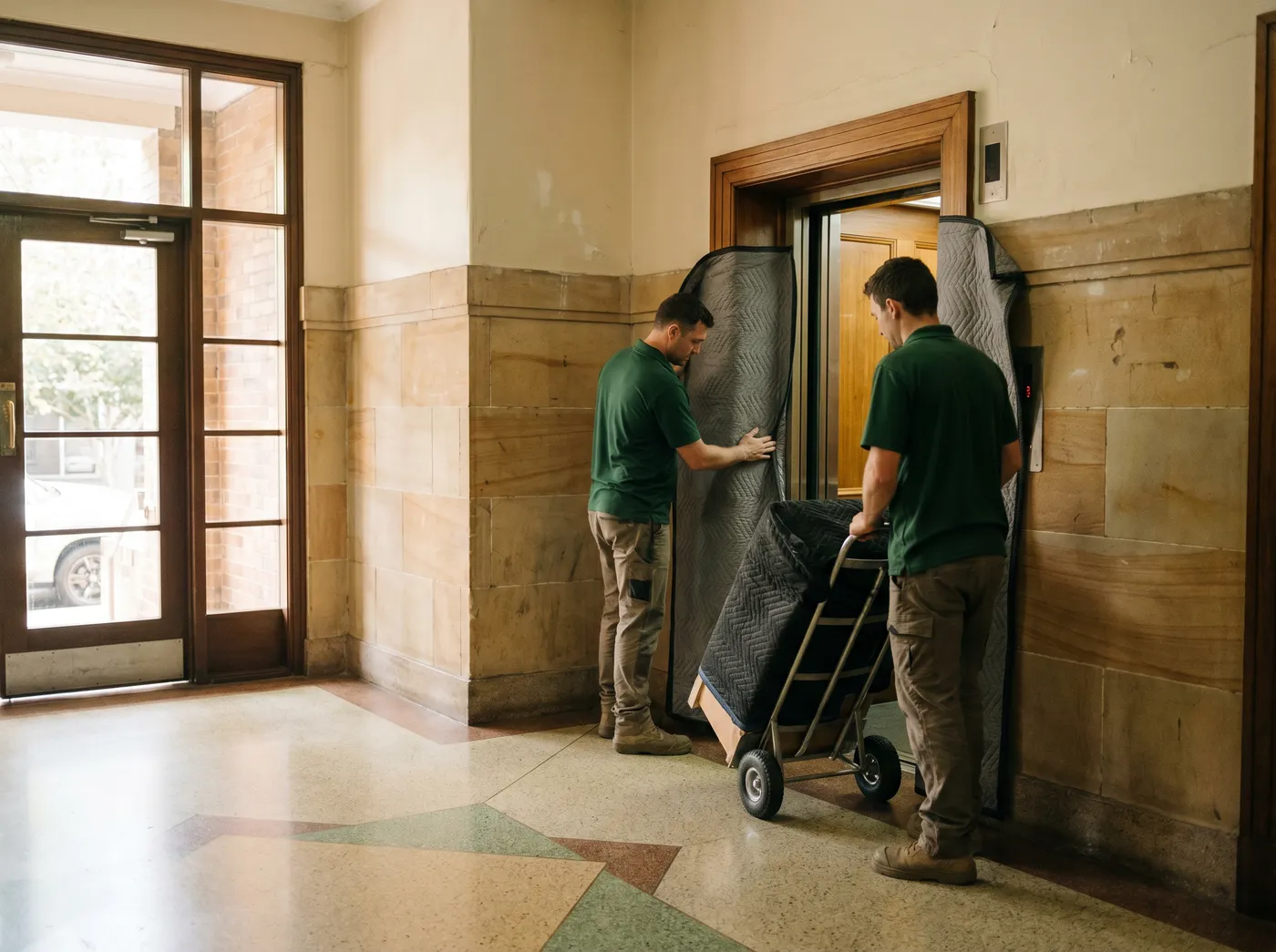

The moving crew carries the keepers. A clearance crew carries the rest.
A downsize done well is two separate jobs that never touch, and the difference is worth being plain about:
- The moving company's truck takes the keepers, padded and handled as furniture in transit should be, and delivers them to your new door.
- The clearance van comes later, for everything staying behind: the furniture not making the trip, the under-house, the shed, the last of the cupboards.
- Nothing crosses between the two. The keepers have left the house, or are plainly marked, before a clearance begins; the two loads never share a room.
- The loads end differently too. One at the apartment; the other at the charity dock, the licensed facilities for the regulated streams, and landfill last of all.
The clearance half is set out plainly on the downsizing clearance page.
What the wrong order costs
Every one of these is common, and every one is avoidable with the sequence above.
- The skip weekend. A skip in the driveway sets a deadline, and deadlines are how things are lost: something gone before anyone asked, good furniture in the bin because the charity run felt slow. On these slope streets there is often nowhere lawful to put one anyway.
- Moving everything, sorting later. Carrying a houseful into an apartment that cannot hold it means paying to move most of it twice, and living among the boxes in between.
- The unbooked lift. A truck at the kerb and a building manager hearing about the move for the first time is how a one-day move becomes two.
- The storage unit with no end date. A unit rented to bridge a settlement gap is sensible. One rented so the deciding can be quietly skipped becomes a monthly bill that outlives the reason for it.
Asked often, about the short move
How early should the lift be booked?
As soon as the date is settled. Every building sets its own notice, so there is no universal rule, only a universal truth: managers who hear early are helpful, and earlier never hurts. When we book a clearance in a strata building we square our own dates with the manager the same way.
Can the leftovers just go out for a council cleanup?
Some can, and when the council is the answer we say so. The cleanup is free but booked, with limits on what it takes and how much, and the contents of a downsized house usually outrun it several times over. The cleanup guide covers where the line sits.
Does the old house need to be cleared straight away?
No, and it usually should not be. Once the keepers are out, the house can wait a week or a month while you settle in; the real deadline is settlement or the listing date, and the clearance is planned backwards from that.
What if something big will not fit in the apartment's lift?
Sometimes the stairs can carry what the lift cannot, where the building allows it, and that is the moving company's call to make. The measuring visit is what turns that from a moving-day drama into a season-early conversation, while there is still time to send a promised piece to family or offer a good one on.
Can you bring a few things to the apartment as well?
Carrying the keepers is the moving crew's job, and we stay deliberately out of it. The exception is the set-aside: when something that matters turns up after the move, a watch under the lining of a drawer, letters in the sideboard, it is kept, shown to you, and brought to the apartment or wherever you ask.
Do we have to be finished choosing before we can get a price?
The price is quoted on what remains, so it firms up once the keepers are decided or plainly marked. But it is never too early to talk: we can look at the house months out, explain how the price behaves, and put a figure in writing when the shape of the move is settled.
The clearance half, handled
The moving company is yours to choose. For everything staying behind, our downsizing clearance is this guide made practical: the keepers protected, one written price settled before we begin, donation before disposal, and swept rooms at the end.
Just planning for now? The walkthrough shows how a clearance runs, one page at a time.